
PCB buyers love certifications because they look like shortcuts: one stamp, less risk.
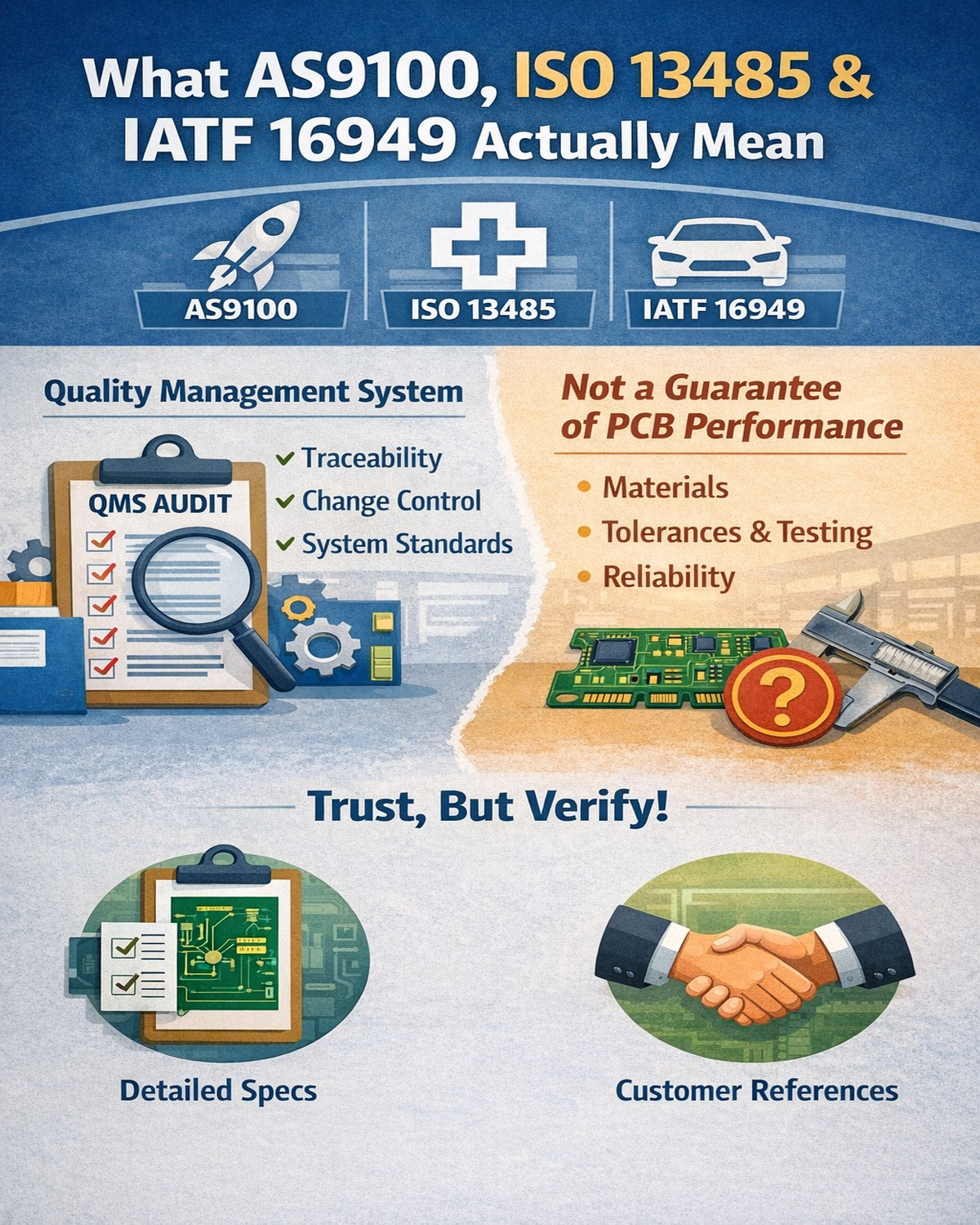
But for aerospace, medical and automative printed circuit boards, the reality is that AS9100, ISO 13485 and IATF 16949 are quality management system (QMS) standards.
They describe how a company controls work, records, suppliers, changes and nonconformances.
They are not a guarantee that your PCB will meet your drawing, your IPC performance class, your reliability targets or your customer flowdowns.
Used correctly, though, they’re powerful signals, especially for traceability and change control, which are where most high-reliability PCB failures start: wrong laminate lot, unapproved process tweak, undocumented rework, missing records.
However, certifications are about the system, not the board.
A QMS certificate tells you:
✅ There’s a defined way to control documents, revisions, training, calibration, suppliers and nonconforming product.
✅ There’s a defined way to keep records and prove what happened.
✅ There’s a defined way to manage change (and in some sectors, it’s aggressively formalized).
But it does 𝘯𝘰𝘵 tell you:
✅ Whether your stackup/material set is locked down
✅ Whether the fab will hold your via wall/copper thickness/impedance tolerances unless specified
✅ Whether the supplier will run the extra coupons, microsections or reliability tests you need
✅ Whether a “certified” site is the one actually building your boards
So the right PCB buyer mindset is:
Use certifications to predict auditability and traceability behavior. Use your PO/spec package to predict product performance. Trust but verify by asking for customer references of like technologies.
Certifications tell you whether the supplier can prove what they did. Your spec tells them what to do. And customer testimonials tell you the truth. You need all three.
𝐍𝐞𝐞𝐝 𝐡𝐞𝐥𝐩 𝐟𝐢𝐧𝐝𝐢𝐧𝐠 𝐭𝐡𝐞 𝐫𝐢𝐠𝐡𝐭 𝐏𝐂𝐁 𝐬𝐮𝐩𝐩𝐥𝐢𝐞𝐫? 𝐃𝐢𝐫𝐞𝐜𝐭𝐏𝐂𝐁 𝐜𝐚𝐧 𝐡𝐞𝐥𝐩! Reach out to us.