
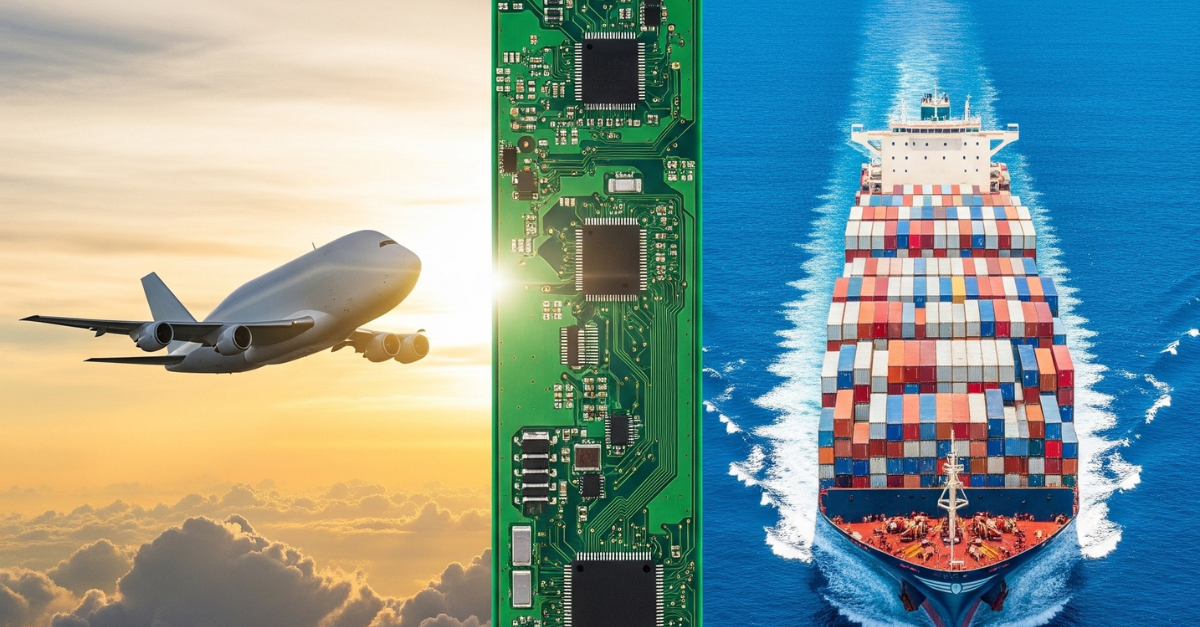
Everyone wants their PCBs “yesterday,” but paying 5 to 10 times more for air freight isn’t always the right business move.
For high-mix, low-volume (HMLV) buyers, the choice between air and sea isn’t just about speed. It’s about cost of capital versus cost of transport.
Here is the math you need to consider for your 2026 supply chain:
1. The Hidden Cost of Sea Freight
Sea freight from China to North America or the EU is significantly cheaper on the invoice (often 80-90% less than air). However, the transit time is 30-45 days versus 5-8 days for air.
The Math: If you ship by sea, you are tying up cash in inventory for an extra month.
The Verdict: If your cost of capital is high or if revisions are frequent (common in HMLV), the “savings” of sea freight can be wiped out by the cost of holding dead stock or delaying revenue.
2. When Air Freight Makes Sense (Despite the Price)
NPI & Prototypes: Speed is the only metric that matters here. Saving $500 on shipping is irrelevant if it delays a product launch by 4 weeks.
High Value-to-Weight Ratio: For complex, high-layer-count boards, shipping is a small percentage of the unit cost. Air freight protects cash flow by allowing smaller, more frequent deliveries.
Line Down Risks: If missing boards stops your assembly line, air freight is the cheapest insurance policy you can buy.
3. The Carbon Calculation (Crucial for EU & ESG-focused US firms)
This is becoming a hard requirement, not just a “nice to have.”
The Stat: Air freight generates approximately 40 to 50 times more CO2 emissions than sea freight per kilogram.
The Strategy: We are seeing more EU clients split orders—flying in the first 10% of a production run to feed the line and putting the remaining 90% on the water to lower the blended carbon footprint (and cost).
The Bottom Line:
Go air for: Prototypes, first production batches and emergency stock.
Go sea for: Stable, high-volume repeats where forecast accuracy is high.
𝐍𝐞𝐱𝐭 𝐒𝐭𝐞𝐩: Stop guessing. Send me your forecasted volume for Q3.
I’ll run a side-by-side comparison of landed costs (air versus sea) so you can see exactly where the breakeven point lies for your specific boards.
Need more info? Reach out to us!